Thursday, May 12, 2011

Assignment 5 - Photography and the Environment

Two images that caught my eye from the protests again woodchipping in Tasmania:


Both images from tasmaniasforests.com.au (no photographer listed).

I chose these two images separately and only when I have put them together do I realise how similar they are in terms of mood and fogginess (I guess I am a sucker for the fog) and similar cool tones. The first one is an image that I found really showed how amazing the forest is and lets the mind imagine what the scene would be without the trees. The lower picture is more on the destruction side. Looking at this image and others like it of the trees burnt out breaks my heart. These images remind me incredibly strongly of Stromlo Forest after the 2003 bushfires, where I spend a lot of time in the forest before and after. These remind me somehow of all the pain inflicted on the inhabitants of the forest and of the sheer feeling of loss while the hills were bare. It took an awfully long time to get parts of the forest on the mend and even then the government is taking vast areas of land previously dedicated to forest in the name of "development." The topic gets me reasonably fired up so I will leave it there. But either way, this image evoked a pretty strong response.

In terms of Tim Bonyhady's When a Picture Packs a Punch, I believe he is correct in saying that the professionalism, quality, and resulting aesthetic beauty of the Dombrovskis images was indeed the reason they had such a great impact on the public. Had they been mere snapshots, I do not believe they would have had the effect of showing people the true beauty and grandeur of the Franklin River in such a way that it would make a difference to so many people. In a way these images have to evoke empathy or emotion in people to create a feeling of not wanting that thing to be destroyed. Should the item in question not be aesthetically beautiful I think there might be other ways to bring forth the same emotion. For exapmle, people photographing endangered animals tend to head more for the cute factor to create this response. Animals that are not suited to this approach either can be photographed in the state which they need saving from  - for example pigs are often photographed in their pens which are far too small, dirty, and do not even allow the pig to move at all. I suppose this is going for the pity response. In terms of forest and nature, you could follow a similar tactic (such as the logs after they have been burnt down after logging) to create a feeling of loss.

Wednesday, May 11, 2011

Assignment 4 - Narrative Photography

With this assignment I wanted to look at a reasonably fundamental, but important, difference in the way that narratives can be told through a photograph or series of photographs. The two photographers I have chosen to illustrate this are Izima Kaoru and Anne Hardy.

Izima Kaoru uses the figure of a person within the scene to tell the story. Whilst at time he relies on the set and props to help the viewer to guess what has happened, largely the figure alone is the key to understanding the narrative. You can see this approach in his "Landscapes with a Corpse" series.

Izima Kaoru
Hasagawa Kyoko wears YSL, 2003

Without the central figure, there would be nothing to suggest what had happened and there would be no real narrative. However, by careful positioning of the figure he encourages us to come to a conclusion on her manner of death and from there, perhaps, why. Whilst the background is important to give background and context to the event, he mainly tells the story through the figure. His style is very closely tied to fashion, as you may be able to tell from the fact that the title is the model's name and the clothes she is wearing. All of his photos (that I have seen so far) are of young, beautiful, dead girls and all are highly polished works that resemble the fashion style of photography. He has other works that use more of the set to tell the story but in general he seems to keep this to a minimum and restrict the narrative qualities mostly to his model.

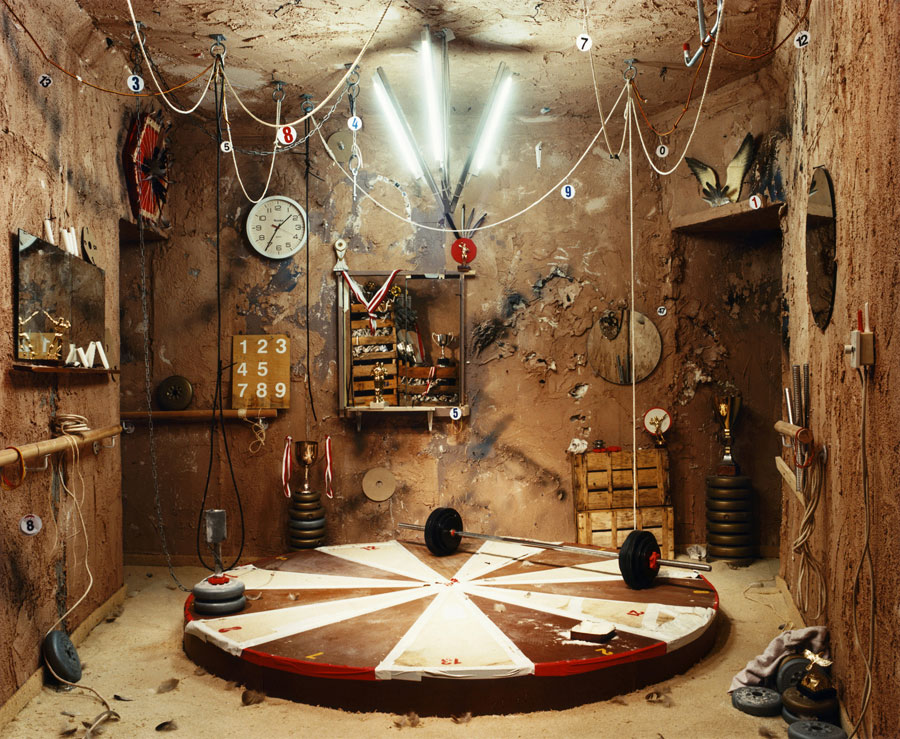
Anne Hardy takes a very different approach. He images rarely involve a character directly. However, she indicates them via the scene in her images. These scenes are exceptionally carefully constructed to suggest both a narrative/story and usually something about the character who inhabited the scene at some point.

Cipher, 2007
Anne Hardy

In Cipher, Hardy creates a scene which gave me the first impression of being an archealogical-type study due to the fact that many objects have been tagged. I suppose it could also be a forensic tag but there is no evidence of a disturbance or crime. These are just my personal thoughts on the image, but the way the scene is set it appears that the inhabitant has left, in no rush but without the inclination to tidy up. The weights and trophies scattered around indicate that the person is a champion weight lifter or athlete of some kind. There are other conclusions you can draw from the small details.

You can notice the difference between the two approaches - in Kaoru's image, the story is told by the figure and the background, while adding context, does not tell much of the narrative, while Hardy's image is almost entirely told through the background via carefully placed props and cues.